
Why Does My Fever Keep Coming Back? Causes, Tests & When to See a Specialist in Bangalore
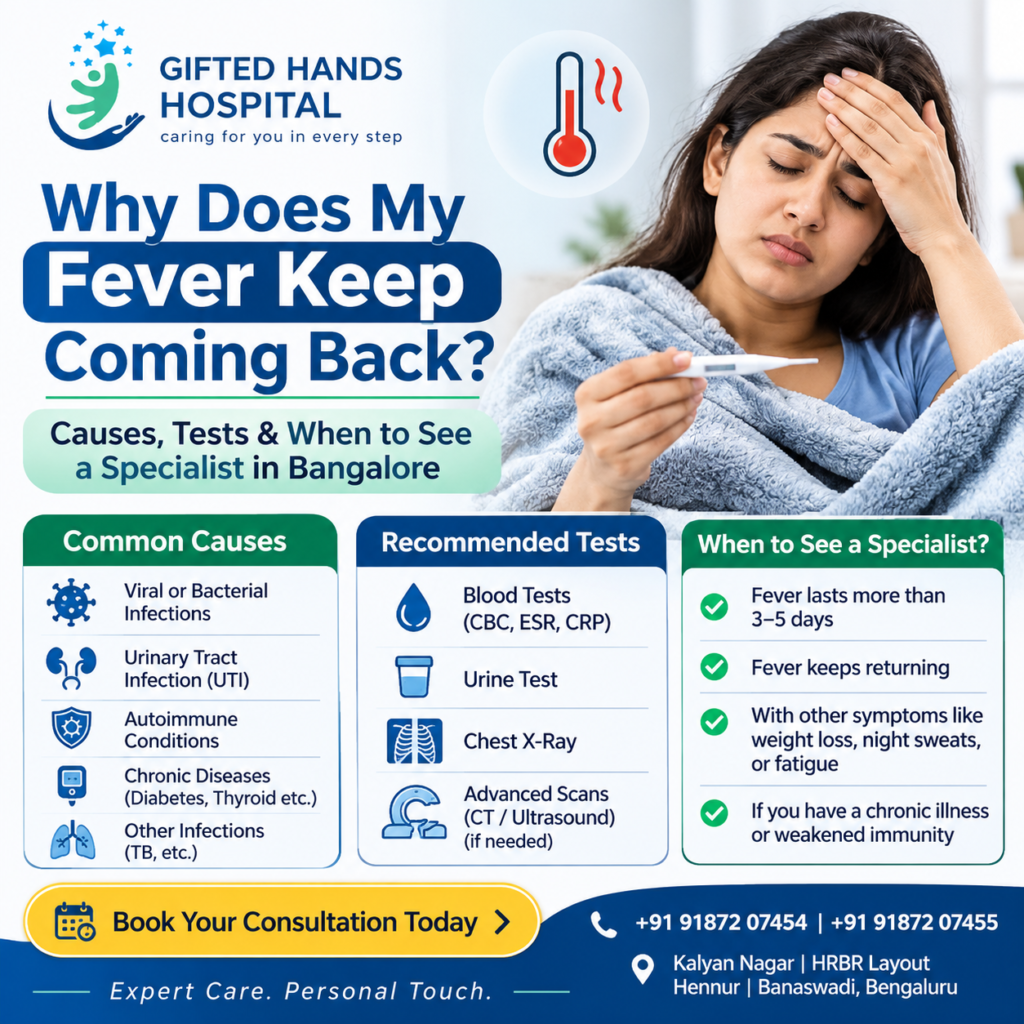
A fever is your body’s natural defence mechanism: a temporary rise in internal temperature triggered by the immune system to fight off invading viruses, bacteria, or inflammation. Most common viral fevers subside within three to five days with rest, hydration, and basic symptomatic medication. However, when a fever temporarily dips after taking paracetamol only to spike again every evening, or returns week after week without an obvious cold or throat infection, it signals an underlying clinical issue that requires structured medical investigation.
For residents seeking reliable persistent fever treatment in Bangalore, ignoring a recurring temperature or repeatedly self-medicating with leftover antibiotics can mask critical symptoms and delay accurate diagnosis. At Gifted Hands Hospital, our internal medicine and infectious disease specialists provide comprehensive fever treatment in Kalyan Nagar, serving families across HRBR Layout, Hennur, Banaswadi, and Kammanahalli with rapid, protocol-driven diagnostic evaluations.
Understanding Recurrent vs. Persistent Fever: What Do the Patterns Mean?
Before ordering laboratory investigations, a seasoned general physician for fever in Kalyan Nagar closely examines your fever chart—specifically how high the temperature rises, how long each episode lasts, and what time of day it peaks. Clinicians categorize returning fevers into three distinct patterns:
- Intermittent Fever: Your body temperature spikes sharply (often in the late afternoon or evening) and returns completely to normal at least once every 24 hours. This pattern is frequently seen in localized bacterial abscesses, tuberculosis, and certain parasitic infections.
- Remittent Fever: The temperature fluctuates throughout the day, dipping slightly after medication but never fully returning to a normal baseline. Typhoid fever, infective endocarditis, and severe respiratory infections commonly present this way.
- Relapsing or Periodic Fever: You experience distinct fever episodes lasting several days, separated by completely fever-free intervals lasting days or weeks. Malaria, cyclical viral reactivations, and autoimmune inflammatory disorders often follow a relapsing timeline.
- Pyrexia of Unknown Origin (PUO / FUO): Medically defined as a documented fever exceeding on multiple occasions over three weeks or longer, remaining undiagnosed despite initial outpatient blood tests. Evaluating PUO requires a dedicated specialist for unexplained fever in Banaswadi or Kalyan Nagar.
Common Causes of Returning Fever in Bangalore
Living in a rapidly urbanizing metropolis like Bengaluru exposes residents to a unique combination of seasonal vector-borne illnesses, waterborne pathogens, respiratory allergens, and chronic lifestyle-linked inflammatory conditions. When evaluating patients looking for a doctor for recurrent fever in Kalyan Nagar, specialists systematically assess five primary categories:
1. Vector-Borne & Tropical Infections (Dengue, Malaria, Chikungunya & Scrub Typhus)
Bengaluru’s monsoon and post-monsoon seasons, alongside localised construction activity, create breeding grounds for Aedes and Anopheles mosquitoes.
- Dengue Fever: Often presents with a classic “saddleback” fever pattern high fever for 3–4 days, a brief 24-hour drop that creates a false sense of recovery, followed by a secondary fever spike accompanied by dropping platelet counts and severe body aches.
- Malaria (P. vivax and P. falciparum): Causes cyclical paroxysms of intense chills, rigors, high fever, and drenching sweats every 48 to 72 hours as parasites rupture red blood cells.
- Scrub Typhus & Rickettsial Fevers: Often overlooked in urban settings, scrub typhus causes prolonged high fever, severe headache, and a characteristic dark scab (eschar) at the mite bite site.
2. Bacterial Infections & Hidden Organ Sepsis
Unlike self-limiting viral infections, bacterial illnesses persist or rebound until targeted antibiotic therapy is completed.
- Enteric Fever (Typhoid & Paratyphoid): Contracted through contaminated food or water, typhoid causes a “step-ladder” rise in fever over successive days, accompanied by abdominal discomfort, coating on the tongue, and constipation or diarrhea.
- Urinary Tract Infections (UTIs) & Pyelonephritis: Recurrent low-grade fevers with chills sometimes without obvious burning urination, especially in older adults and diabetics often originate from silent kidney or bladder infections requiring specialized urology and urinary tract care.
- Tuberculosis (Pulmonary & Extrapulmonary TB): India’s leading cause of prolonged evening-rise fever. Extrapulmonary TB (affecting lymph nodes, abdomen, spine, or pleura) frequently causes low-grade afternoon fevers, night sweats, loss of appetite, and unexplained weight loss without any cough.
- Hidden Abscesses & Sinus/Dental Infections: Deep-seated liver abscesses, pelvic infections, chronic sinusitis, or untreated dental root infections can release bacteria intermittently into the bloodstream.
3. Viral Reactivations & Post-Viral Syndromes
Certain viruses remain dormant inside the body after an initial infection and reactivate when immunity dips due to stress, poor sleep, or nutritional deficiencies.
- Epstein-Barr Virus (EBV) & Cytomegalovirus (CMV): Cause prolonged fever, swollen neck lymph nodes, extreme fatigue, and mild liver enzyme elevation.
- Post-Viral Inflammatory Fatigue: Following severe influenza, COVID-19, or RSV, thermoregulatory centers in the brain can remain temporarily sensitized, producing mild afternoon temperature fluctuations for two to three weeks.
4. Autoimmune & Connective Tissue Disorders
When infectious panels repeatedly return negative, an infectious disease specialist in Kalyan Nagar collaborates with internal medicine specialists to screen for non-infectious inflammatory triggers. Conditions such as Systemic Lupus Erythematosus (SLE), Rheumatoid Arthritis, Adult-Onset Still’s Disease, and Vasculitis cause the immune system to attack healthy tissues, generating persistent fevers accompanied by joint stiffness, skin rashes, or mouth ulcers.
5. Drug-Induced Fever & Endocrine Imbalances
Ironically, medications prescribed to treat an initial illness including certain antibiotics (beta-lactams, sulfonamides), anti-seizure drugs, and herbal supplements can trigger a hypersensitivity drug fever that resolves only when the offending agent is stopped. Additionally, thyroiditis (subacute inflammation of the thyroid gland) frequently mimics a lingering throat infection with neck tenderness and low-grade fever.
Why Self-Medicating With Antibiotics Makes Recurrent Fever Worse
A widespread habit across urban households is taking leftover antibiotics (such as azithromycin or amoxicillin) for two days whenever a fever flares up, and stopping as soon as the temperature drops. This practice creates three serious clinical hazards:
- Partial Suppression & Rebound: Sub-therapeutic antibiotic doses temporarily suppress bacterial multiplication without eradicating the infection, causing the fever to bounce back stronger days later.
- False-Negative Blood Cultures: Taking even a single dose of an antibiotic before visiting a diagnostic lab can sterilize blood samples just enough to prevent bacteria from growing in culture, making accurate fever diagnosis in Hennur or Kalyan Nagar significantly harder.
- Antimicrobial Resistance (AMR): Incomplete courses train bacteria to resist standard first-line medications, requiring stronger intravenous therapies later.
Essential Diagnostic Tests for Persistent & Recurrent Fever
Rather than ordering random, expensive test bundles, a structured fever specialist near HRBR Layout follows a tiered diagnostic pathway tailored to your symptom duration and physical examination. At Gifted Hands Hospital’s advanced diagnostic laboratory and pathology center, evaluations typically progress through three clear stages:
Tier 1: Baseline Fever Screening (Days 3 to 5 of Fever)
- Complete Blood Count (CBC) with Peripheral Smear: Evaluates white blood cell (WBC) counts (elevated in bacterial infections, low in viral/dengue fevers), platelet levels, and directly visualizes malaria parasites under a microscope.
- Inflammatory Markers (CRP & ESR): C-Reactive Protein (CRP) and Erythrocyte Sedimentation Rate (ESR) measure the intensity of systemic inflammation.
- Rapid Antigen & Serology Panel: Dengue NS1 Antigen (most accurate in days 1–5), Dengue IgM/IgG antibodies (days 5+), Malaria Rapid Diagnostic Test (RDT), and Typhidot IgM / Widal screening.
- Urine Routine & Microscopy: Detects hidden urinary white cells, nitrites, or bacteria.
Tier 2: Targeted Microbiological & Organ Function Tests (Days 5 to 10)
- Blood & Urine Cultures (Prior to Antibiotics): The gold standard for identifying exact bacterial pathogens and determining which specific antibiotic will eliminate them completely.
- Liver & Kidney Function Tests (LFT & KFT): Checks for hepatic inflammation (common in typhoid, viral hepatitis, dengue, and leptospirosis) and assesses kidney filtration.
- Scrub Typhus & Leptospira Serology: Essential when high fevers persist beyond a week without respiratory or urinary symptoms.
Tier 3: Advanced Imaging & Specialist Panels (Fevers > 10–14 Days)
- Chest X-Ray & High-Resolution CT: Rules out atypical pneumonia, hidden lung lesions, or enlarged mediastinal lymph nodes.
- Abdominal & Pelvic Ultrasound: Performed via our ultrasound and Color Doppler imaging unit to detect silent liver abscesses, gallbladder inflammation, appendicitis, or enlarged abdominal lymph nodes.
- Autoimmune & Thyroid Profiles: ANA (Antinuclear Antibody), Rheumatoid Factor, Serum Ferritin, and Thyroid Function Tests (TSH, Free T3/T4) for unexplained prolonged fevers.
| Diagnostic Investigation | Primary Clinical Purpose | Ideal Timing |
| CBC + Peripheral Smear | Checks WBC trends, platelets & malaria parasites | Day 2–3 onwards |
| Dengue NS1 & IgM/IgG | Confirms acute vs. late-phase dengue infection | NS1: Days 1–5 / IgM: Day 5+ |
| Blood Culture & Sensitivity | Identifies bloodstream bacteria & exact antibiotic match | Before starting antibiotics |
| CRP & Procalcitonin | Distinguishes bacterial sepsis from viral inflammation | Day 3–5 onwards |
| Abdominal Ultrasound | Detects silent liver abscess, kidney infection, or nodes | Fever lasting > 7 days |
Red-Flag Warning Signs: When to See a Specialist Immediately
While mild viral fevers can be monitored safely at home with hydration and rest, you should consult an infectious disease doctor near Kalyan Nagar or visit an urgent care facility immediately if your returning fever is accompanied by any of the following red flags:
- Fever Lasting Beyond 5 Days: Any fever that fails to resolve after five days or returns after a 24–48 hour break.
- Temperature Spiking Above: Especially if unresponsive to standard paracetamol dosing.
- Severe Headache, Neck Stiffness, or Confusion: Potential signs of meningitis, encephalitis, or severe systemic infection.
- Persistent Vomiting or Inability to Keep Fluids Down: Rapidly leads to dangerous dehydration and electrolyte imbalance.
- Shortness of Breath, Chest Pain, or Persistent Cough: Warrants prompt respiratory and pulmonology evaluation.
- Unexplained Skin Rash, Bleeding Gums, or Nosebleeds: Critical warning signs of dengue hemorrhagic complications or platelet drops.
- Drenching Night Sweats & Unintentional Weight Loss: Classic indicators requiring evaluation for tuberculosis, lymphoproliferative disorders, or chronic inflammatory disease.
- High-Risk Medical History: Infants, elderly individuals over 65, pregnant women, diabetics, and patients on immunosuppressive medications should seek specialist evaluation within 24–48 hours of fever onset.
Why Choose Gifted Hands Hospital for Persistent Fever Treatment in Bangalore?
When dealing with a baffling, recurring temperature, fragmented clinic visits and delayed lab reports only prolong patient anxiety. Located strategically on Hennur Banasawadi Road in HRBR Layout 1st Block, Gifted Hands Hospital brings together experienced clinicians and precision diagnostics under one roof:
- Dedicated Internal Medicine & Infectious Disease Expertise: Our general medicine and internal medicine department is led by senior physicians experienced in unraveling complex fevers of unknown origin without unnecessary over-medication.
- Hyper-Local Accessibility Across North & East Bengaluru: Whether you are searching for a general physician for fever in Kalyan Nagar, a trusted fever specialist near HRBR Layout, rapid fever diagnosis in Hennur, or an experienced specialist for unexplained fever in Banaswadi, our hospital is minutes away from your neighborhood.
- Same-Day Integrated Diagnostics: In-house pathology, automated blood culture systems, digital X-ray, and high-resolution ultrasound ensure rapid turnaround times so targeted treatment starts on day one.
- Multidisciplinary Backup: Seamless coordination across gastroenterology and hepatology care, pulmonology, and urology whenever a fever traces back to an organ-specific infection.
Practical Home Care Tips While Awaiting Your Test Results
Until your doctor confirms the exact root cause of your recurring fever, follow these evidence-based supportive measures:
- Maintain a Detailed Fever Diary: Record your exact temperature (using a digital thermometer) every 6 hours, noting the time of spikes, chills, and when you took fever-reducing medication. Bring this log to your consultation.
- Prioritize Aggressive Hydration: Fever accelerates fluid loss through sweating and rapid breathing. Sip Oral Rehydration Salts (ORS), coconut water, clear vegetable broths, and plain water consistently throughout the day.
- Stick Strictly to Paracetamol for Fever Control: Unless explicitly advised by your physician, avoid self-medicating with NSAIDs (like ibuprofen, diclofenac, or mefenamic acid) during early fever days in Bangalore, as these drugs can worsen bleeding risks if the underlying illness turns out to be dengue.
- Use Lukewarm Sponging: If temperature climbs above $102^\circ\text{F}$, sponging the forehead, armpits, and limbs with lukewarm (never ice-cold) water helps dissipate heat safely without triggering shivering.
Frequently Asked Questions (FAQs)
1. Why does my fever go down with paracetamol during the day and come back every night?
Paracetamol temporarily blocks prostaglandin chemicals in the brain’s temperature-regulating center for 4 to 6 hours; once the medication wears off, the underlying infection or inflammation triggers a fresh spike. Additionally, natural cortisol (the body’s anti-inflammatory hormone) drops in the evening, making infections like typhoid, tuberculosis, and viral illnesses flare up at night.
2. How many days of returning fever is considered serious?
Any fever that persists beyond 4 to 5 days, or disappears for a day or two before returning, warrants clinical evaluation by a doctor for recurrent fever in Kalyan Nagar or your nearest internal medicine specialist to rule out dengue, typhoid, malaria, or hidden bacterial infections.
3. Can stress or lack of sleep cause a recurring low-grade fever?
While psychological stress alone rarely pushes body temperature above $100.4^\circ\text{F}$, chronic sleep deprivation weakens immune surveillance, allowing dormant viruses (like EBV) or mild upper respiratory and sinus infections to flare repeatedly.
4. Should I take antibiotics if my fever keeps coming back?
No. Over 70% of acute fevers are viral or vector-borne, where antibiotics have zero effect. Taking unprescribed antibiotics can cause side effects, promote drug resistance, and interfere with accurate blood culture results.
5. Which doctor should I consult for a fever that won’t go away in Bangalore?
Start with an experienced internal medicine physician or an infectious disease specialist in Kalyan Nagar at Gifted Hands Hospital. They specialize in systematic fever workups, infectious disease panels, and complex pyrexia of unknown origin.
6. What blood tests are needed for a fever lasting more than 5 days?
A comprehensive 5-day fever workup typically includes a Complete Blood Count (CBC), CRP, Liver Function Test (LFT), Blood Culture, Dengue IgM/IgG, Malaria smear/antigen, Typhoid serology, and Urine Routine examination.
7. Where can I get fast fever diagnosis near HRBR Layout, Hennur, and Banaswadi?
Gifted Hands Hospital on Hennur Banasawadi Road (HRBR Layout 1st Block) offers same-day outpatient consultations, full laboratory fever panels, and ultrasound diagnostics for residents across Kalyan Nagar, HRBR Layout, Hennur, and Banaswadi.
Book Your Fever Evaluation at Gifted Hands Hospital Today
A returning fever is your body’s way of asking for a deeper look beneath the surface. Instead of guessing with over-the-counter pills, get clarity and targeted relief from an experienced infectious disease specialist in Kalyan Nagar and HRBR Layout. Book an appointment online at Gifted Hands Hospital or visit our outpatient department today for a thorough, personalized fever evaluation.

