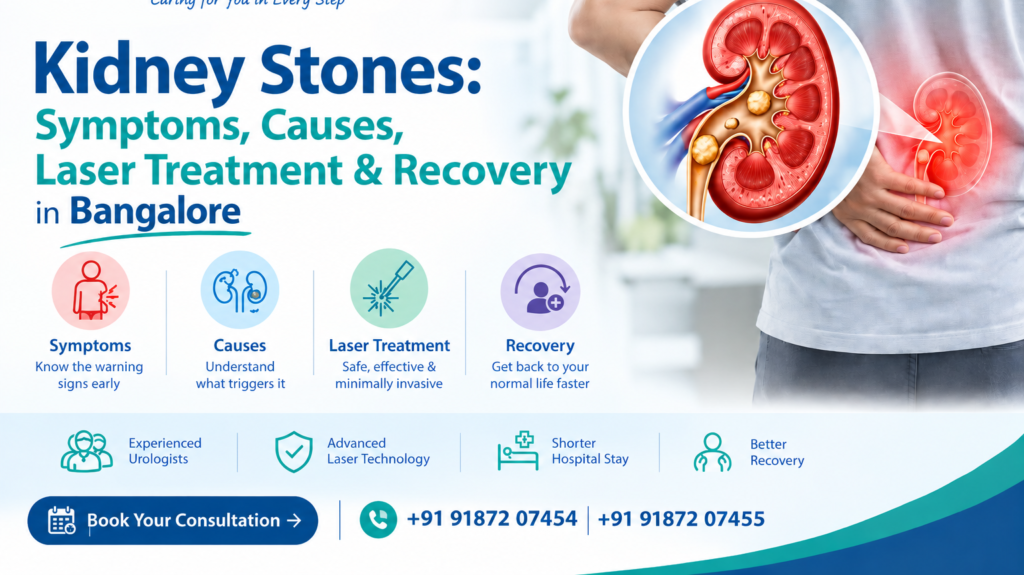
Kidney Stones: Symptoms, Causes, Laser Treatment & Recovery in Bangalore
Kidney stones can strike suddenly, turning an ordinary day into an agonizing struggle with sharp flank pain, nausea, and urinary discomfort. If you or a loved one are experiencing these symptoms, you are not alone. Millions of individuals suffer from renal calculi (kidney stones) annually, with urban lifestyle factors, inadequate hydration, and dietary habits significantly contributing to their incidence in India.
When searching for effective kidney stone treatment in Bangalore, patients are often overwhelmed by the variety of surgical and non-surgical procedures available. Today, medical technology has evolved far beyond invasive open surgeries. Advanced laser kidney stone surgery in Bangalore offers a quick, virtually painless, and highly effective solution that allows patients to return home within 24 hours.
At Gifted Hands Hospital, located conveniently for residents of Kalyan Nagar, HRBR Layout, and surrounding North Bangalore areas, our board-certified urologists combine cutting-edge laser tech with compassionate care. In this comprehensive guide, we break down everything you need to know about kidney stone symptoms, root causes, advanced treatment options, cost considerations, and long-term prevention strategies.
Understanding Kidney Stones: Causes & Risk Factors
Kidney stones are hard mineral and salt deposits that form inside your kidneys. They occur when urine becomes concentrated, allowing minerals to crystallize and stick together. Over time, these crystals grow into stones ranging in size from a tiny grain of sand to large golf ball-sized masses.
Common Causes of Kidney Stones:
- Dehydration: Not drinking enough water is the primary cause of stone formation. Hot climates like Bengaluru’s summer months accelerate fluid loss, increasing mineral concentration in the kidneys.
- Dietary Factors: High consumption of sodium, animal proteins, refined sugars, and oxalate-rich foods (such as spinach, nuts, and chocolate) significantly increases risk.
- Family History: A genetic predisposition to kidney stones makes certain individuals more likely to develop recurrent stones.
- Metabolic Disorders & Medical Conditions: Hyperparathyroidism, gout, urinary tract infections (UTIs), and inflammatory bowel diseases can disrupt normal urine chemistry.
- Obesity & Sedentary Lifestyle: High body mass index (BMI) and physical inactivity are strongly linked to altered urinary pH levels and stone formation.
Recognizing Early Kidney Stone Symptoms
Small kidney stones may pass through the urinary tract silently without causing noticeable discomfort. However, as stones move or grow large enough to block urine flow within the ureter or kidney, sharp and intense symptoms emerge.
Recognizing early kidney stone symptoms ensures timely intervention before serious complications like severe infections or kidney damage occur:
- Severe Flank Pain: A sharp, intense pain in the lower back, side, or below the ribs that comes in waves and fluctuates in intensity.
- Radiation of Pain: Pain radiating downward into the lower abdomen and groin area.
- Dysuria (Painful Urination): A burning sensation or sharp pain during urination.
- Hematuria (Blood in Urine): Urine appearing pink, red, or brownish due to micro-tears in the urinary tract lining.
- Urgent & Frequent Urination: Feeling a persistent, sudden need to urinate, often passing only small amounts of urine.
- Cloudy or Foul-Smelling Urine: A strong indicator of an underlying urinary tract infection associated with the stone.
- Nausea and Vomiting: Systemic nerve triggers between the kidneys and gastrointestinal tract frequently cause stomach upset.
- Fever and Chills: Warning: Fever alongside kidney pain is a medical emergency indicating a severe kidney or urinary infection that requires immediate medical care.
Comprehensive Kidney Stone Treatment Options
When evaluating kidney stone treatment options, your doctor will consider stone size, location, composition, and your overall health. Modern urology offers tailored solutions ranging from conservative monitoring to high-precision surgical removal.
       +-------------------------------------------------------+
       |             KIDNEY STONE DIAGNOSIS & SIZE            |
       +-------------------------------------------------------+
                                  |
            +---------------------+---------------------+
            |                                           |
    [ Small Stone (< 5mm) ]                     [ Large Stone (> 5mm) ]
            |                                           |
  ( Conservative Management )                   ( Interventional Therapy )
  • High Hydration (3L+/day)                            |
  • Alpha-blockers / Pain Relief        +---------------+---------------+
  • Dietary Modifications               |               |               |
                                   [ Laser RIRS ]   [ ESWL ]      [ PCNL ]
                                   (Retrograde)   (Shockwave)   (Keyhole)
1. Non-Surgical Medical Management (Small Stones < 5mm)
Small stones under 5 mm often pass naturally with minimal medical intervention. Treatment focuses on:
- Aggressive Hydration: Drinking 2.5 to 3 liters of water daily to flush out the stone.
- Medical Expulsive Therapy (MET): Medications like alpha-blockers relax the muscles in your ureter, helping the stone pass faster and with less pain.
- Pain Management: Over-the-counter or prescribed analgesics control acute pain episodes.
2. Extracorporeal Shock Wave Lithotripsy (ESWL)
ESWL uses targeted high-energy acoustic shock waves from outside the body to break medium-sized stones into fine sand-like particles that can pass in urine. While non-invasive, it may require multiple sessions and is less effective for hard or complex stones.
3. Modern Laser Kidney Stone Surgery in Bangalore (RIRS & URSL)
For larger, hard, or stubborn stones, holmium or thulium laser lithotripsy represents the gold standard in urology. Laser technology allows urologists to reach and vaporize stones deep within the kidney without making a single incision on your body.
- URSL (Ureteroscopic Lithotripsy): Used primarily for stones located in the lower or middle ureter. A ultra-thin scope is passed through the natural urinary passage to dust the stone using laser fiber energy.
- RIRS (Retrograde Intrarenal Surgery): A flexible endoscope is guided through the urethra and bladder directly into the kidney. A high-precision laser beam pulverizes the stone into microscopic dust particles, which are then naturally flushed out or safely extracted using special baskets.
4. Percutaneous Nephrolithotomy (PCNL / Mini-PCNL)
For exceptionally large (> 2 cm) or staghorn stones, keyhole surgery called PCNL is performed. A tiny 1 cm incision is made in the back to directly access, break down, and extract the stone fragments.
Why Choose Laser Kidney Stone Removal Treatment at Gifted Hands Hospital?
When searching for an experienced urologist in Bangalore or specialised kidney stone removal treatment in Kalyan Nagar and HRBR Layout, facility expertise and medical infrastructure are critical.
================================================================================
                     GIFTED HANDS HOSPITAL ADVANTAGES
================================================================================
 [✓] 100% Incision-Free Procedures (No external scars or sutures)
 [✓] High Clearance Success Rates (95%+ stone clearance in single session)
 [✓] Same-Day Discharge / 24-Hour Stay Options
 [✓] Ultra-Precise Holmium/Thulium Laser Technology
 [✓] Dedicated Urological Care Center in Kalyan Nagar & HRBR Layout
================================================================================
At Gifted Hands Hospital, our urological team specializes in advanced kidney stone removal treatment, delivering faster recovery, zero visible scarring, and minimal downtime.
Local Accessibility for North Bengaluru Residents
Patients seeking high-quality kidney stone treatment in Kalyan Nagar, HRBR Layout, Kammanahalli, or surrounding North Bengaluru neighborhoods do not need to travel across congested city corridors for world-class care. Gifted Hands Hospital offers:
- Rapid emergency response for acute flank pain management.
- Comprehensive diagnostic ultrasound and low-dose CT urography under one roof.
- Transparent clinical guidance on procedure selection, costs, and insurance coverage.
Comparative Matrix: Laser Treatment vs. Traditional Procedures
To help you make an informed decision about kidney stone removal treatment, here is how modern laser surgery compares to older, conventional methods:
| Feature / Metric | Laser Surgery (RIRS / URSL) | Shockwave Lithotripsy (ESWL) | Keyhole Surgery (PCNL) | Traditional Open Surgery |
| Surgical Incisions | None (Natural Access) | None | Minimal (1 cm Keyhole) | Large Incision (10-15 cm) |
| Stone Clearance Rate | Very High (95%+) | Moderate (70–80%) | High (90–95%) | High (90%+) |
| Anesthesia Required | General / Regional | Local / Light Sedation | General Anesthesia | General Anesthesia |
| Hospital Stay | Day Care / 24 Hours | Outpatient (Same Day) | 2–3 Days | 5–7 Days |
| Recovery Time | 2 to 3 Days | 3 to 5 Days | 1 to 2 Weeks | 4 to 6 Weeks |
| Pain Level Post-Op | Minimal | Mild to Moderate | Moderate | Severe |
| Suitability | All sizes & positions | Small to medium (<1.5cm) | Very large (>2cm) stones | Rarely required today |
Kidney Stone Surgery Cost in Bengaluru & Financial Options
Understanding the financial commitment is an essential part of your healthcare plan. The overall cost of laser kidney stone surgery in Bangalore varies depending on factors such as stone size, location, choice of room category, hospital stay duration, and surgeon expertise.
- Estimated Cost Range in Bengaluru: ₹45,000 to ₹1,25,000+
- Insurance Assistance: Kidney stone procedures (RIRS, URSL, PCNL) are standard covered treatments under most corporate and individual health insurance policies.
- Cashless Desk: Gifted Hands Hospital provides dedicated insurance desk support to process cashless claims efficiently, reducing out-of-pocket stress during emergency admissions.
- Flexible Payment Options: No-cost EMI schemes and structured payment plans are available for non-insured patients to ensure timely treatment without delay.
Recovery Timeline & Post-Treatment Prevention Protocols
Recovery following modern laser surgery is swift, but adopting preventative lifestyle habits is crucial to prevent stone recurrence, which affects nearly 50% of patients within five years if untreated.
Post-Surgery Recovery Steps
- Hydration Routine: Fluid intake should be increased to 3–3.5 liters per day to aid the natural clearance of micro-particles.
- Double-J (DJ) Stent Care: A temporary soft internal stent may be placed in the ureter to facilitate tissue healing and ensure smooth urine flow. Minor urinary urgency or mild irritation during urination is normal while the stent is in place.
- Resuming Normal Activities: Most patients resume desk work and light activities within 48 to 72 hours following laser treatment.
Actionable Dietary Tips for Stone Prevention
- Increase Citrate Intake: Drink fresh lemon water, lime water, or orange juice daily. Citrate binds to urinary calcium, preventing crystal formation.
- Moderate Sodium Consumption: High salt levels cause the kidneys to excrete more calcium into the urine. Keep daily salt intake below 2,300 mg.
- Maintain Healthy Dietary Calcium: Do not eliminate dietary calcium (such as milk, yogurt, and cheese). Calcium binds to oxalates in your digestive tract before reaching your kidneys.
- Reduce Excessive Animal Protein: Limit heavy intake of red meat, poultry, and seafood, which raises urinary uric acid levels.
Frequently Asked Questions (SEO FAQs)
Q1: Is laser kidney stone surgery painful?
A: No. Laser kidney stone surgery (RIRS or URSL) is performed under anesthesia, meaning you feel no pain during the procedure. Post-operative discomfort is minimal and easily managed with prescribed oral medications.
Q2: How long does it take to recover after laser kidney stone removal?
A: Most patients are discharged within 24 hours of surgery and can comfortably return to normal work and daily routine activities in 2 to 3 days.
Q3: What is the best kidney stone treatment option available in Bengaluru?
A: Retrograde Intrarenal Surgery (RIRS) using laser energy is widely considered the gold-standard treatment for medium-to-large kidney stones. It is scarless, safe, highly efficient, and offers the fastest recovery time.
Q4: Can kidney stones return after laser treatment?
A: While laser surgery removes 100% of existing stone material, new stones can form in the future if underlying diet, fluid intake, and metabolic factors are not corrected. Following a tailored dietary plan reduces recurrence risk by over 80%.
Q5: How do I choose a top urologist in Bangalore for kidney stone surgery?
A: Look for a board-certified urologist experienced in advanced endourology and laser techniques (RIRS/URSL), modern diagnostic infrastructure, positive patient reviews, and access to a well-equipped hospital near you.
Q6: Where can I get specialized kidney stone treatment in Kalyan Nagar and HRBR Layout?
A: Gifted Hands Hospital provides specialized urology services and advanced laser stone removal treatments conveniently accessible for patients living in Kalyan Nagar, HRBR Layout, Kammanahalli, and nearby North Bengaluru localities.
Q7: Will health insurance cover laser kidney stone removal treatment?
A: Yes, most major health insurance policies in India cover laser kidney stone surgeries like URSL, RIRS, and PCNL. Gifted Hands Hospital offers seamless cashless insurance assistance for hassle-free processing.
Conclusion: Take Charge of Your Urological Health
Ignoring early kidney stone symptoms can lead to severe pain, severe urinary tract infections, and long-term kidney function impairment. Modern advances in laser kidney stone surgery in Bangalore have made stone removal safe, precise, scar-free, and quick.
If you are looking for an experienced urologist in Bangalore or comprehensive kidney stone removal treatment in Kalyan Nagar or HRBR Layout, contact Gifted Hands Hospital today.
- Website: Gifted Hands Hospital
- Specialty: Advanced Urological Care & Incision-Free Laser Surgery
- Action: Schedule an expert consultation today and live pain-free!

