
Piles (Hemorrhoids): Symptoms, Causes & Advanced Treatment Options in Kalyan Nagar, Bangalore
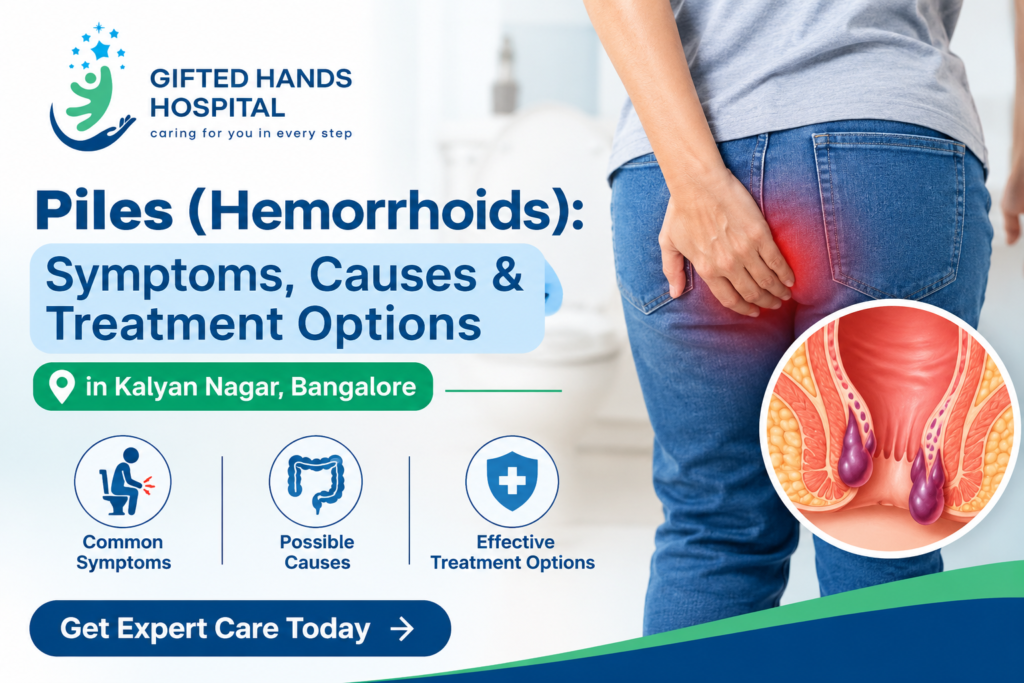
Dealing with rectal discomfort, persistent itchiness, or rectal bleeding during bowel movements can be distressing. These symptoms often indicate piles (medically termed hemorrhoids), a common condition affecting millions of adults worldwide. Despite how widespread the condition is, many people delay seeking professional medical help due to hesitation or embarrassment.
Delaying diagnosis can lead to disease progression, transforming manageable symptoms into severe complications requiring immediate intervention. If you are seeking advanced, compassionate, and effective piles treatment in Kalyan Nagar, Bangalore, understanding the underlying causes, diagnostic grades, and non-invasive surgical solutions is the first step toward lasting recovery.
At Gifted Hands Hospital, our team of experienced proctologists and general surgeons provides comprehensive, patient-centric care using state-of-the-art diagnostic tools and minimally invasive laser technologies. Explore our specialized General Surgery & Proctology Services to learn more about how we diagnose and treat anorectal disorders. Whether you are looking for an expert piles doctor in Kalyan Nagar, HRBR Layout, Banaswadi, Kammanahalli, or Hennur, this guide provides deep insight into symptoms, causes, and modern treatment options.
Understanding Piles (Hemorrhoids): What Are They?
Piles, or hemorrhoids, are swollen, inflamed blood vessels located in the vascular cushions of the lower rectum and anus. Under normal anatomical conditions, these tissue cushions assist in controlling bowel movements. However, when excessive pressure is applied to the pelvic floor and anal area, these veins become dilated, stretched, and engorged with blood, leading to the formation of symptomatic piles.
       +-------------------------------------------------------+
       |                  TYPES OF PILES                       |
       +---------------------------+---------------------------+
                                   |
         +-------------------------+-------------------------+
         |                                                   |
         v                                                   v
+-------------------------------+   +-------------------------------+
|        INTERNAL PILES         |   |        EXTERNAL PILES         |
| • Located inside rectum       |   | • Located under skin around   |
| • Usually painless            |   |   the anus                    |
| • Primary sign: Bright red    |   | • Painful, sensitive to touch |
|   bleeding                    |   | • Risk of painful thrombosis  |
+-------------------------------+   +-------------------------------+
Internal and External Piles: Key Differences
Understanding whether you have internal and external piles is essential for establishing an accurate diagnosis and customized treatment plan:
- Internal Piles: These originate inside the rectum above the pectinate line. Because the tissue high in the rectum lacks pain-sensing nerves, internal piles are typically painless in their early stages. The primary sign of internal piles is bright red blood coating the stool or dripping into the toilet bowl during defecation. If left untreated, internal hemorrhoids can stretch downward and prolapse outside the anal verge.
- External Piles: These develop under the sensitive skin surrounding the anus below the pectinate line. Because this skin is rich in somatic pain nerve endings, external piles frequently cause noticeable discomfort, swelling, itching, and pain—especially while sitting or walking. External piles can also form a painful localized blood clot, a condition known as thrombosed external hemorrhoids.
The 4 Grades of Piles (Hemorrhoids Classification)
Medical specialists classify internal hemorrhoids into four distinct grades of piles based on their severity and degree of prolapse. Understanding these grades helps determine whether conservative management or modern laser intervention is required.
| Grade of Piles | Clinical Description | Primary Symptoms | Primary Recommended Treatment |
| Grade I | Small, internal vascular swellings that do not prolapse outside the anal canal. | Painless bleeding during bowel movements; no visible mass. | Dietary modifications, increased fluid intake, topical medications. |
| Grade II | Hemorrhoids prolapse outside the anus during straining or bowel movements but spontaneously reduce (retract back inside) on their own. | Intermittent rectal bleeding, mild itching, feeling of anal fullness. | Conservative therapy, lifestyle changes, non-surgical procedures. |
| Grade III | Hemorrhoids prolapse during bowel movements or physical exertion and do not spontaneously reduce. They must be manually pushed back inside. | Frequent bleeding, mucous discharge, dull pain, perianal skin irritation. | Minimally Invasive Laser Hemorrhoidoplasty (LHP) / Advanced procedure. |
| Grade IV | Chronic, non-reducible prolapsed tissue that remains permanently outside the anal verge; may include strangulated or thrombosed tissue. | Constant discomfort, severe pain, profuse bleeding, risk of infection or necrosis. | Advanced surgical intervention or Laser Piles Operation. |
Common Piles Symptoms to Recognize Early
Recognizing piles symptoms early prevents the condition from advancing from manageable Grade I or II stages to complicated Grade III or IV stages.
                  +-----------------------------------+
                  |      COMMON PILES SYMPTOMS        |
                  +-----------------+-----------------+
                                    |
     +-----------------+------------+------------+-----------------+
     |                 |                         |                 |
     v                 v                         v                 v
+----------+    +--------------+          +------------+    +--------------+
| Rectal   |    | Swelling /   |          | Rectal     |    | Mucus        |
| Bleeding |    | Prolapsed    |          | Pain &     |    | Perianal     |
| (Bright  |    | Lumps        |          | Irritation |    | Itching      |
| Red)     |    |              |          |            |    |              |
+----------+    +--------------+          +------------+    +--------------+
Painless vs. Painful Bleeding Piles
- Rectal Bleeding: The most frequent indicator of bleeding piles is bright red blood appearing on toilet paper, in the bowl, or on the surface of stool. The blood is characteristically bright red because it originates from arteriovenous networks.
- Prolapsed Lumps: Feeling a soft bulge or swollen mass around the anal opening during or after bowel movements.
- Anal Pain and Discomfort: While early internal piles are painless, external hemorrhoids, thrombosed piles, or prolapsed hemorrhoids squeezed by the anal sphincter cause severe, constant pain.
- Perianal Itching and Irritation: Mucus secretions from prolapsed internal piles can irritate the sensitive skin surrounding the anus, leading to persistent itching (pruritus ani).
- Incomplete Bowel Evacuation: A continuous sensation that bowel movements are incomplete, often leading patients to strain excessively.
What Causes Piles? (Root Causes & Risk Factors)
Piles causes generally trace back to excessive intra-abdominal and pelvic venous pressure. When pressure within the rectal vascular meshwork increases over time, the tissues supporting these veins stretch, dilate, and weaken.
- Chronic Constipation and Straining: Frequent straining during bowel movements exerts extreme pressure on pelvic veins, causing them to swell and prolapse.
- Low-Fiber Diets: Consuming diets heavy in processed foods and refined carbohydrates leads to hard, dry stools that are difficult to pass.
- Sedentary Lifestyle and Prolonged Sitting: Sitting for extended periods—especially on the toilet or at an office desk—impairs blood circulation in the pelvic region, promoting venous congestion.
- Pregnancy and Childbirth: Elevated hormonal levels relax vascular walls, while the growing uterus places direct physical pressure on the inferior vena cava and pelvic veins.
- Chronic Diarrhea: Frequent, explosive loose bowel movements cause recurring irritation and inflammation of the anal tissue.
- Heavy Weightlifting and Physical Strain: Improper breathing techniques during heavy weightlifting increase intra-abdominal pressure, predisposing individuals to vascular engorgement.
- Aging: As people age, the connective tissues supporting the rectum and anal sphincter weaken, making hemorrhoidal prolapse more likely.
Diagnostic Methods for Hemorrhoids
Accurate diagnosis by a piles specialist in Bangalore ensures that symptoms are correctly identified and that other gastrointestinal conditions—such as anal fissures, fistulas, polyps, or colorectal malignancy are ruled out. You can consult our team of specialists directly by visiting the Gifted Hands Hospital Expert Doctors Page.
                       +-------------------------+
                       |    DIAGNOSIS OF PILES   |
                       +------------+------------+
                                    |
          +-------------------------+-------------------------+
          |                         |                         |
          v                         v                         v
+-------------------+     +-------------------+     +-------------------+
|  PHYSICAL EXAM    |     |    DGT / DRE      |     |    ANOSCOPY /     |
| Visual inspection |     | Digital Rectal    |     |  SIGMOIDOSCOPY    |
| of perianal area  |     | Examination       |     | Direct internal   |
| for external piles|     | to feel internal  |     | visualization of  |
| & tissue prolapse |     | masses & sphincter|     | mucosal lining &  |
|                   |     | muscle tone       |     | hemorrhoid grade  |
+-------------------+     +-------------------+     +-------------------+
- Visual Clinical Examination: Direct physical evaluation of the perianal area to assess external hemorrhoids, skin tags, inflammation, or thrombosed tissue.
- Digital Rectal Examination (DRE): The specialist inserts a lubricated, gloved finger into the rectum to evaluate muscle tone, check for internal masses, and assess tenderness.
- Anoscopy / Proctoscopy: Using a brief, illuminated diagnostic scope (anoscope) to directly visualize the internal lining of the lower rectum and anus. This allows precise staging of the grades of piles.
- Sigmoidoscopy or Colonoscopy: Recommended if bleeding is dark red, if the patient is over 45, or if there is a family history of colorectal cancer.
Advanced Piles Treatment Options Available in Kalyan Nagar
Effective hemorrhoids treatment varies based on the grade, severity, and duration of symptoms. Modern proctology emphasizes non-invasive and minimally invasive techniques that prioritize fast recovery and patient comfort.
                    +------------------------------------+
                    |     PILES TREATMENT OPTIONS        |
                    +-----------------+------------------+
                                      |
     +--------------------------------+--------------------------------+
     |                                                                 |
     v                                                                 v
+-----------------------------------+             +-----------------------------------+
|     CONSERVATIVE & MEDICAL        |             |      SURGICAL & MINIMALLY INVASIVE|
+-----------------------------------+             +-----------------------------------+
| • Dietary High-Fiber Adjustments  |             | • Rubber Band Ligation (Grade I/II)|
| • Warm Sitz Baths & Topical Creams|             | • Conventional Hemorrhoidectomy   |
| • Stool Softeners & Oral Drugs    |             | • Modern Laser Hemorrhoidoplasty  |
+-----------------------------------+             +-----------------------------------+
Non-Surgical & Dietary Management
For Grade I and early Grade II piles, non-surgical approaches can successfully alleviate symptoms:
- Dietary Fiber Optimization: Increasing daily fiber intake to 25–35 grams using psyllium husk, whole grains, pulses, fresh fruits, and vegetables helps produce softer, bulkier stools.
- Hydration: Drinking 2.5 to 3 liters of water daily ensures stool remains soft and moves smoothly through the intestinal tract.
- Sitz Baths: Soaking the pelvic area in a tub of warm water for 15 minutes, two to three times a day, relaxes the anal sphincter muscle and relieves local burning and swelling.
- Topical Ointments & Suppositories: Over-the-counter or prescribed creams containing mild hydrocortisone, lidocaine, or vascular tonics provide temporary relief from local itching and discomfort.
Conventional Piles Surgery vs. Modern Laser Hemorrhoidoplasty
When conservative measures prove insufficient, surgical intervention becomes necessary. However, traditional piles operation methods have evolved into advanced, laser-assisted procedures.
  CONVENTIONAL HEMORRHOIDECTOMY            MODERN LASER HEMORRHOIDOPLASTY
+-------------------------------+        +-------------------------------+
| • Surgical incision with knife|        | • Target laser energy beam    |
| • Open painful wound          |   VS   | • No open cuts or stitches    |
| • 3-6 weeks recovery period   |        | • 24-48 hours fast recovery   |
| • High risk of infection      |        | • Minimal bleeding & pain     |
+-------------------------------+        +-------------------------------+
| Feature / Metric | Conventional Surgical Hemorrhoidectomy | Advanced Laser Hemorrhoidoplasty (LHP) |
| Surgical Technique | Manual excision of swollen tissue with scalpel/cautery. | Controlled laser beam energy focused to shrink blood vessels. |
| Incision & Sutures | Open wounds, extensive tissue cutting, and sutures required. | No open cuts, zero tissue excision, no sutures needed. |
| Post-Operative Pain | Moderate to severe pain requiring prolonged pain medication. | Minimal to negligible pain; highly comfortable recovery. |
| Blood Loss | Significant operative and post-operative bleeding risk. | Virtually bloodless procedure due to laser coagulation. |
| Hospital Stay | 2 to 4 days of inpatient hospitalization. | Day-care procedure; discharge within 24 hours. |
| Recovery Period | 3 to 6 weeks of resting and restricted activity. | Normal daily routines resume within 48 to 72 hours. |
| Risk of Infection / Incontinence | Higher risk of wound infection and sphincter damage. | Preserves sphincter muscle integrity; near-zero infection risk. |
Why Choose Laser Piles Operation at Gifted Hands Hospital?
If you are looking for an expert piles doctor in Kalyan Nagar, Gifted Hands Hospital provides world-class healthcare combined with patient-centered compassionate care. Learn more about our mission and facility standards on our About Gifted Hands Hospital Page.
- Expert Proctologists & Surgeons: Our surgical team includes experienced piles specialists in Bangalore trained in advanced laser proctology techniques.
- State-of-the-Art Laser Facilities: We utilize precision diode laser technology to treat internal and external hemorrhoids safely and efficiently.
- Painless Day-Care Procedures: Patients undergoing laser treatment experience minimal post-operative discomfort, no visible scarring, and can usually return home the same day.
- Comprehensive Care Plans: From pre-operative evaluations to post-procedure nutritional guidance, our team ensures complete support throughout your recovery.
Comprehensive Piles Care Near You: Serving Kalyan Nagar & Nearby Areas
Finding a trusted piles hospital in Kalyan Nagar means choosing a facility that offers prompt diagnostic consultations and modern treatment options close to home. Gifted Hands Hospital serves residents across North Bangalore:
- Piles treatment in HRBR Layout: Located adjacent to Kalyan Nagar, patients in HRBR Layout can quickly access expert proctology consultations.
- Piles treatment in Banaswadi: Convenient, top-rated care for families living throughout the Banaswadi area.
- Piles doctor in Kammanahalli: Access experienced proctologists for comprehensive evaluations and laser therapies.
- Piles treatment in Hennur: Nearby access to modern day-care procedures and non-surgical piles management.
If you reside in any of these North Bangalore neighborhoods and are seeking a piles treatment near me, our hospital is conveniently accessible with full outpatient and inpatient surgical facilities.
Prevention and Post-Treatment Lifestyle Guidelines
Preventing piles recurrences after treatment requires adopting healthy long-term daily habits.
                  +-----------------------------------+
                  |     PILES PREVENTION LIFESTYLE    |
                  +-----------------+-----------------+
                                    |
     +-----------------+------------+------------+-----------------+
     |                 |                         |                 |
     v                 v                         v                 v
+----------+    +--------------+          +------------+    +--------------+
| High     |    | Adequate     |          | Never      |    | Active       |
| Fiber    |    | Hydration    |          | Suppress   |    | Daily        |
| Diet     |    | (2.5-3L/day) |          | Urge to    |    | Exercise     |
|          |    |              |          | Defecate   |    |              |
+----------+    +--------------+          +------------+    +--------------+
- Maintain High-Fiber Dietary Habits: Include legumes, oats, flaxseeds, leafy greens, apples, and whole grains in your daily meals.
- Stay Consistently Hydrated: Drink plenty of water throughout the day to keep stools soft and easy to pass.
- Avoid Straining on the Toilet: Respond to the urge to pass stool immediately. Sitting on the toilet for prolonged periods (e.g., using smartphones while sitting) increases pressure on pelvic veins.
- Engage in Regular Physical Activity: Moderate exercise, such as 30 minutes of walking daily, stimulates healthy intestinal motility and prevents constipation.
- Avoid Prolonged Sedentary Sitting: Take regular breaks to stand up and stretch if your work requires sitting at a desk for long hours.
Frequently Asked Questions (FAQs)
1. What is the main cause of piles?
Piles are primarily caused by increased pressure in the pelvic and anal blood vessels. Common contributing factors include chronic constipation, excessive straining during bowel movements, prolonged sitting, low-fiber diets, pregnancy, and heavy lifting.
2. How do I know if I have internal or external piles?
Internal piles occur inside the rectum and are typically painless, presenting primarily as bright red bleeding during bowel movements. External piles form under the skin around the anus, often causing visible swelling, pain, itchiness, or localized bleeding.
3. Are piles and hemorrhoids the exact same medical condition?
Yes. “Piles” is the common lay term for the medical condition known as “hemorrhoids.” Both terms refer to swollen and inflamed vascular tissues in the rectum and anal area.
4. Can piles heal on their own without surgery?
Early-stage piles (Grade I and mild Grade II) often resolve or improve with non-surgical management, including dietary changes, increased fluid intake, fiber supplements, sitz baths, and topical medications. However, Grade III and IV piles usually require medical procedures such as laser treatment.
5. What are the 4 grades of piles?
Piles are graded from I to IV based on severity:
- Grade I: Internal swelling without prolapse.
- Grade II: Prolapses during bowel movements but retracts spontaneously.
- Grade III: Prolapses and requires manual reduction.
- Grade IV: Permanent prolapse that cannot be manually reduced.
6. Is laser piles surgery completely painless?
Laser hemorrhoidoplasty is a minimally invasive procedure performed under local or short regional anesthesia. Post-operative pain is dramatically lower than traditional open surgery, with most patients reporting only mild discomfort that resolves within 24–48 hours.
7. How long does recovery take after a laser piles operation?
Most patients undergoing laser piles operation at Gifted Hands Hospital resume light daily activities within 24 to 48 hours and return to work within 3 to 5 days.
8. What is the difference between bleeding piles and non-bleeding piles?
Bleeding piles occur when enlarged hemorrhoidal blood vessels rupture during the passage of hard stool, releasing bright red blood. Non-bleeding piles present primarily as tissue prolapse, pain, itchiness, or swelling without active bleeding.
9. When should I consult a piles doctor in Kalyan Nagar?
You should consult a specialist immediately if you experience rectal bleeding, persistent anal pain, a prolapsed mass, severe itching, or changes in your normal bowel habits.
10. Is hospitalization required for laser piles treatment?
Laser treatment is usually performed as a day-care procedure. Patients are typically admitted, treated, and discharged on the same day without needing an extended hospital stay.
11. Can piles recur after modern laser treatment?
The recurrence rate following precision laser hemorrhoidoplasty is extremely low (under 5%), especially when patients follow recommended post-operative dietary and lifestyle guidelines.
12. Are there non-surgical options available for piles treatment near me?
Yes, non-surgical treatment options include dietary fiber management, stool softeners, topical anti-inflammatory ointments, warm sitz baths, and office-based procedures such as rubber band ligation.
13. Which doctor should I visit for piles treatment in Bangalore?
You should consult a General Surgeon or a Proctologist who specializes in colorectal disorders and advanced laser proctology procedures.
14. What dietary changes help manage and prevent piles?
Eat a diet rich in high-fiber foods (beans, whole grains, vegetables, fresh fruits), drink 2.5 to 3 liters of water daily, and avoid spicy, fried, or heavily processed foods that can aggravate constipation.
Take the First Step Toward Pain-Free Living
Living with the pain, itching, or discomfort of piles is unnecessary. With modern, minimally invasive laser treatments available at Gifted Hands Hospital, you can achieve lasting relief with quick recovery and minimal downtime.
If you are looking for a trusted piles doctor in Kalyan Nagar, HRBR Layout, Banaswadi, Kammanahalli, or Hennur, our expert proctology team is here to support you.
- Hospital Location: Kalyan Nagar, HRBR Layout 1st Block, Banasawadi Road, Bengaluru, Karnataka 560043
- Services Offered: Proctology, Advanced Laser Piles Surgery, General Surgery, & Comprehensive Diagnostic Care
- Website: Gifted Hands Hospital Official Website

